Male LiposuctionClients

Tummy Tuck + HD Liposuction
Age: 34
#SS056
View Details
Tummy Tuck
Age: 46
#SS066
View Details
HD Liposuction
Age: 56
#SS083
View Details
Abdominal Etching
Age: 31
#SS086
View Details
Tummy Tuck + HD Liposuction
Age: 30
#SS087
View Details
HD Liposuction + Mini Tummy Tuck
Age: 44
#SS088
View Details
Abdominal Etching
Age: 39
#SS089
View Details
Fat Transfer
Age: 44
#SS090
View Details
Liposuction
Age: 30
#SS091
View Details
HD Liposuction + Abdominal Etching
Age: 36
#SS093
View Details
Gynecomastia + HD Liposuction
Age: 29
#SS094
View Details
HD Liposuction + Mini Tummy Tuck
Age: 31
#SS095
View Details
Liposuction
Age: 34
#SS096
View Details
Gynecomastia + HD Liposuction
Age: 37
#SS098
View Details
BBL
Age: 29
#SS100
View Details
Tummy Tuck + HD Liposuction
Age: 34
#SS101
View Details
Renuvion
Age: 28
#SS102
View Details
Back Liposuction
Age: 57
#SS103
View Details
HD Liposuction + Tummy Tuck
Age: 44
#SS104
View Details
Gynecomastia
Age: 26
#SS208
View Details
Gynecomastia
Age: 38
#SS318
View Details
Tummy Tuck
Age: 52
#SS338
View Details
High Definition Liposuction
Age: 55
#SS339
View Details
Renuvion
Age: 37
#SS340
View Details
Liposuction Revision
Age: 51
#SS341
View DetailsWhat Male Liposuction of the Abdomen Changes
Male liposuction of the abdomen removes the fat that hides the rectus, the external oblique, and the serratus, and it clears fat from the lower back and the flanks. Those flanks are the love handles. The aim is a more defined abdomen than traditional liposuction, which thins a layer without drawing the separate muscles. The six-pack look is the gullies around muscle that is already there. It is not a new muscle, and it is not a claim that every abdomen will show six separate packs.
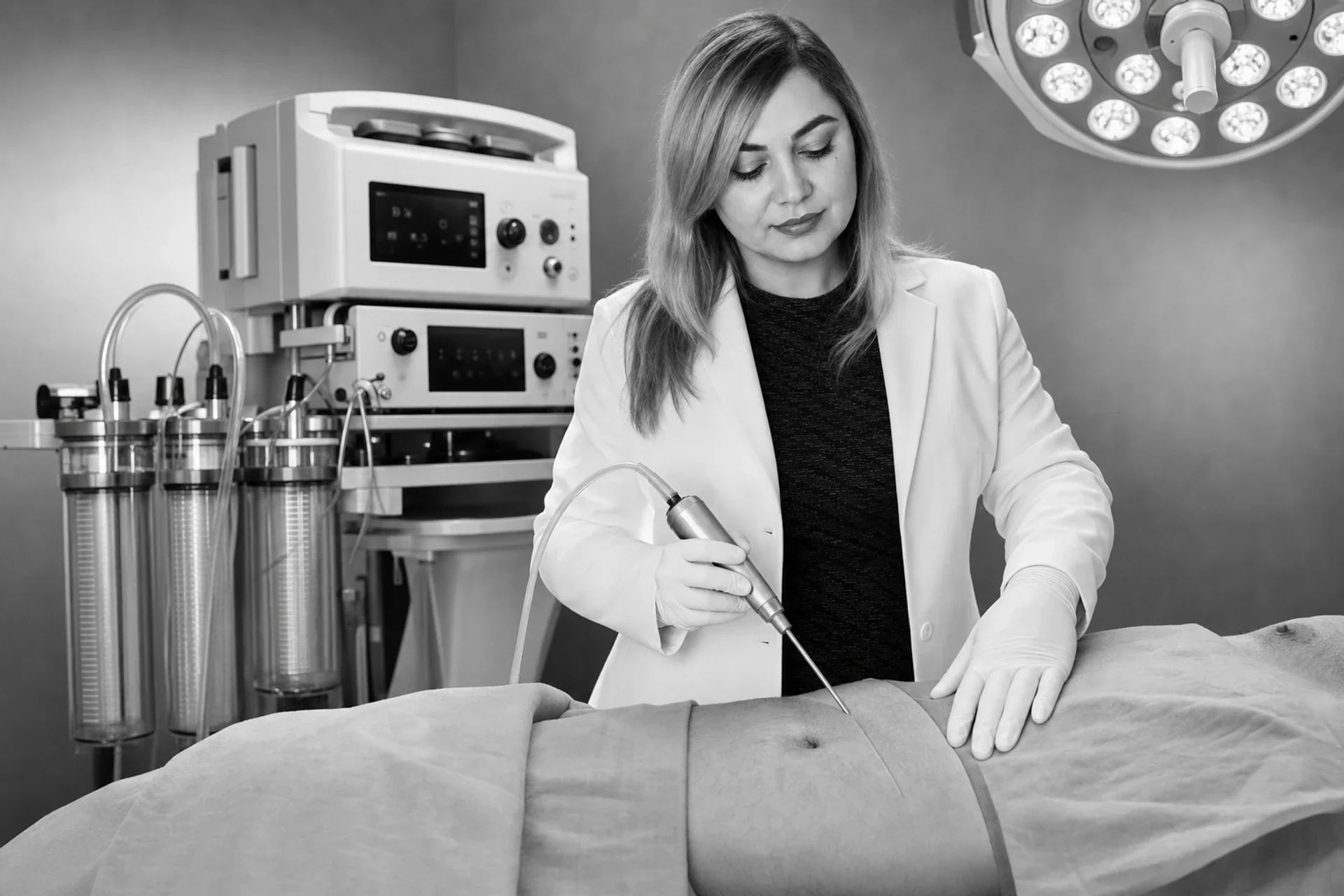
The American Society of Plastic Surgeons describes liposuction as the removal of fat through small incisions. On this operation the fat is prepared with VASER, which uses ultrasound so the fat can be melted before it is taken out. Melting the fat is what makes comprehensive removal, and selective removal, practical. Selective removal is how the muscle is given a three-dimensional shape. The same sculpting has been called 4D liposuction when it is planned both with the muscle still and with the muscle moving.
The Lines Male Liposuction of the Abdomen Follows
The horizontal lines are the inscriptions across the rectus. The vertical line in the center is the linea alba. The vertical lines on either side are the semilunar lines. Defining the gullies along those three sets of lines is how the rectus is made to read as separate segments. The external oblique and the serratus sit lateral to the rectus, and they can be sculpted in the same operation so the side of the abdomen is not left as one smooth slope.
Those lines are the map for male liposuction of the abdomen. Fat is taken more thoroughly in the gully and less thoroughly over the muscle belly, which is the opposite of thinning the whole abdomen by the same amount. The lower back and the flanks are included so the love handles do not sit beside a defined rectus. Leaving the flanks full would keep the torso wide even if the central abdomen were etched.
Skin After the Fat Comes Off
Taking fat comprehensively makes extra skin a separate problem. At the first exam the surgeon looks at how much fat is present, where it sits, how much extra skin there is, and whether the skin texture has changed. The amount of extra skin is graded, and that grade chooses the next step. A small amount of extra skin can be left to retract after VASER alone.
Moderate extra skin can be treated with Renuvion J plasma. The wand goes through the same ports used for the liposuction, so it does not add an incision. J plasma tightens skin by heating collagen under the skin and in the soft tissue. It is the step used when retraction from liposuction alone would not be enough, and when the extra skin is not so extensive that it has to be cut out.
Moderate to severe extra skin on the abdomen is cut out. The incision sits low, at the pubic level, so underwear or swimming trunks cover it. How long that incision is, and how much skin is removed, is decided for that person. When the extra skin is moderate and limited to the lower abdomen, a mini tummy tuck is the excision. When the extra skin reaches above the belly button, a modified abdominal skin resection is used so the whole abdomen can still be treated with liposuction. When the extra skin wraps from the abdomen onto the lower back, the incision continues around the back. That extension is a lateral thigh tuck. These patients are often unable to maintain a healthy weight, and they carry fat over the lower back and the flanks.
The love handles have their own fork of that same choice. When the skin still has elasticity, they are treated with tumescent liposuction, VASER, and Renuvion J plasma. When the extra skin is extensive, they are included in the lateral thigh tuck. Liposuction does not tighten a large sheet of loose skin by itself.
Time, Anesthesia, and the Ports
The operation takes as little as 2 hours and as long as 5 hours. The longer cases are the ones that also have to manage extra skin, and the time is longer still when the excision extends around the back as a lateral thigh tuck. Fat removal alone, without a skin excision, is the shorter end of that range.
Anesthesia is general. The reason given is the discomfort of taking fat comprehensively, including scraping fat off muscle, where there is more sensation, rather than the partial removal done with tumescent solution alone. Because general anesthesia is required, the operation is done in a surgical suite.
The liposuction ports are about 3 mm. They are placed in the pubic region, in the belly button, and in the crease below the chest. When the operation uses only those ports, the scars are negligible. A skin excision is a different scar, and it is planned only when the extra skin requires it. Patients go home the same day unless a more extensive operation is being done at the same time.
The Chest Planned With the Abdomen
Abdominal etching is often done in the same plan as an armor plate chest. The chest is treated either with gynecomastia surgery or by creating that armor plate shape. The three areas in this plan are the abdomen, the love handles on the lower back and flanks, and the chest. The exam decides which of those three actually need surgery. It does not add the chest automatically.
Gynecomastia surgery depends on fat, gland, and skin. Firm skin, little gland, and extra fat can be treated with liposuction only. Most patients have extra gland, so they need liposuction and direct excision of the gland under the nipple and areola. Less often, the skin is very loose and the breast sags. Those patients need excision of skin, fat, and gland, and the nipple and areola are replaced as a skin graft.
Scars follow that same split. Liposuction, and excision of gland alone, use limited incisions, and scarring is not the main concern. When skin, fat, and gland are all excised, the scars are placed to mimic an armor plate. Those scars typically stay red for a few months and then fade toward thin white lines. Gynecomastia is particularly common in newborns, in adolescents, and in older men, when hormone levels swing. An abnormal ratio of estrogen to testosterone affects the breast tissue.
Insurance usually does not cover this chest surgery, because the enlargement is not treated as a threat to physical health. Policies differ. In the uncommon case where the enlarged breasts are documented as causing psychological harm, the surgeon helps determine whether coverage can be obtained. That question is separate from the abdominal etching.
Recovery and What Remains
After male liposuction of the abdomen, the first week is the initial recovery. Driving waits until oral pain medication has been stopped. Daily activity is expected within about 10 days. Compression garments are worn for two weeks. The gym and full physical activity wait until four weeks. Pain is described as minimal to moderate.
A change in the abdomen can be seen right away, including the day after surgery. Generalized swelling sets in at one week. That swelling resolves after one month. The early look and the one-week swelling are not the settled result.
Fat cells removed from the treated layer do not grow back in that layer. Because the removal is comprehensive, a modest weight gain is not expected to refill the etched lines. A major weight gain can still change the abdomen, which is why the result is described as lasting when weight stays steady. The lines are a change in fat, not a change in how the person eats or trains afterward.
A protruding belly from visceral fat can remain. Visceral fat is the fat inside the abdomen, around the organs, and liposuction does not remove it. The common contour concern after surgery is extra skin, not that internal fat. Extra skin is treated with a tuck or with Renuvion. A later excision of leftover skin is uncommon. Before surgery the abdomen is examined for fat, skin, and muscle integrity, health and laboratory values are checked, and nutrition is prepared.
Frequently Asked Questions
It removes fat so the rectus, the obliques, and the serratus can be seen as separate shapes, and it clears the lower back and the flanks. The lines follow the inscriptions, the linea alba, and the semilunar lines. It is a different plan from liposuction that only thins the abdomen by the same amount everywhere.
The operation runs from 2 hours to 5 hours. It is longer when extra skin has to be removed, and longer again when that excision extends around the back as a lateral thigh tuck. General anesthesia is used, in a surgical suite.
Daily activity is expected within about 10 days, and driving waits until pain medication has stopped. Garments stay on for two weeks. Full exercise and the gym wait until four weeks. Swelling that appears at one week settles after one month.
Fat cells removed from the treated layer do not grow back there. A modest gain is not expected to refill lines that were cleared comprehensively. A major weight gain can still change the abdomen.
No. Fat inside the abdominal cavity is not removed by liposuction, so a belly that protrudes because of that fat can remain. Loose skin is a different problem, and it is treated with retraction, Renuvion, or an excision, depending on how much skin is left.
Serving Los Angeles & Orange County
Explore locations near you, then book a consult in Santa Monica or plan surgery in Laguna Beach.
Related reading
Continue with guides on this topic, or jump to a procedure, cost, or location page.